
Welcome to the High-Throughput Screening Knowledge Center (HTSKC)
**The HTBC has transitioned to the High-Throughput Screening Knowledge Center (HTS KC) Please feel free to contact Bruce Koch (bkoch@stanford.edu) or David Solow-Cordero (desolow@stanford.edu) if you have any questions. Our services, compound screening, and equipment are all available as in the past.
The High-Throughput Screening Knowledge Center's mission is to provide researchers at Stanford with the ability to run high-throughput chemical , siRNA , cDNA , and high-content screens for the purpose of drug and/or target discovery.
The HTBC, the precursor to the HTSKC was a Stanford University School of Medicine core facility and was created in 2003 by the Department of Chemical and Systems Biology (formerly Molecular Pharmacology). In 2022, the HTBC became the Sarafan ChEM-H HTSKC with funding from the Innovative Medicines Accelerator (IMA). The HTSKC is a shared resource (Bioscience Screening Facility) for the Stanford Cancer Institute.
This high-throughput screening (HTS) laboratory allows Stanford researchers and others to discover novel modulators of targets that otherwise would not be practical in industry. The center incorporates instrumentation (purchased with NCRR NIH Instrumentation grant numbers S10RR019513, S10RR026338, S10OD025004, and S10OD026899), databases , compound libraries , and personnel whose previous sole domains were in industry.
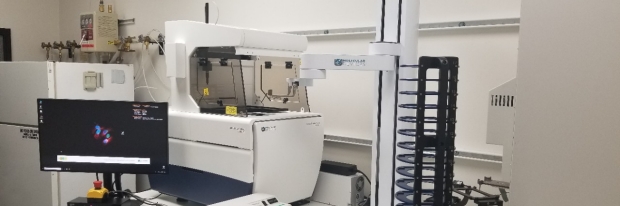
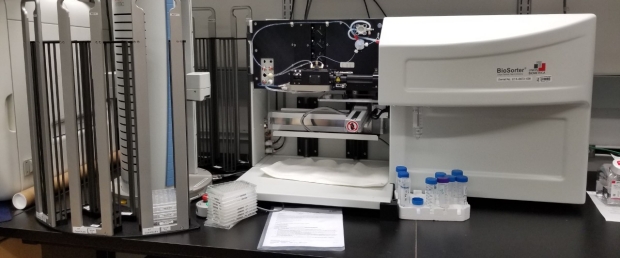
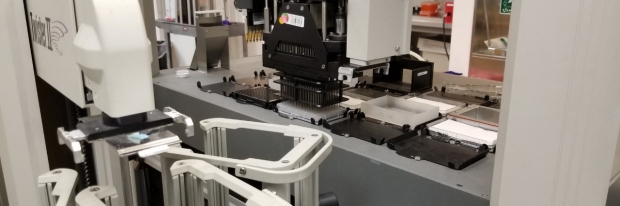
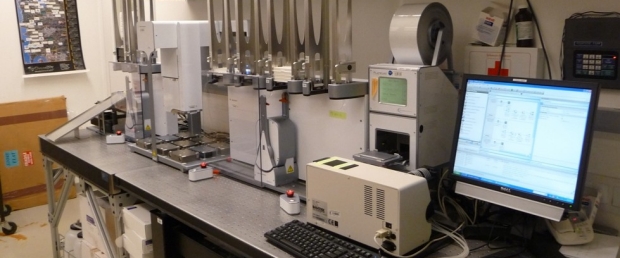
Among our instrumentation are a fully automated Molecular Devices ImageXpress Micro Confocal High-Content fluorescence microplate imager, with live cell, fluidics and phase contrast options, a Union Biometrica Biosorter large object sorter, a Caliper Life Sciences SciClone ALH3000 and an Agilent Bravo microplate liquid handler, and the Tecan Infinite M1000 and M1000 PRO and Molecular Devices Analyst GT and FlexStation II 384 fluorescence, luminescence and absorbance multimode microplate readers.
We have over 180,000 small molecules for compound screens, 15,000 cDNAs for genomic screens, and whole genome siRNA libraries targeting the human genome (the siARRAY whole human genome siRNA library from Dharmacon, targeting 21,000 human genes) and the mouse genome (Qiagen mouse whole genome siRNA set V1 against 22,124 genes).
For more information on our services please contact the HTSKC Director, Dr. Bruce Koch or Associate Director Dr. David E. Solow-Cordero.
HTSKC Information, Forms, New Information, and Downloads
HTSKC IS USING iLAB FOR ALL SCHEDULING AND BILLING.
PLEASE REGISTER HERE.
Non-Stanford and other External Researchers can Register Here
**NEW for 2019, Molecular Devices ImageXpress Micro CONOFCAL** Automated Confocal High Content Imaging Microscope.
Coming Soon: Information on new HTSKC Screening System located in the Sarafan ChEM-H Building.